Reviewing an AI-assisted purchase

Buying something through an AI assistant involves handing over a series of small decisions. The assistant has to interpret the request and decide which details matter, often before the customer has seen any products. A delivery deadline might rule out the cheapest option. A substitute might be acceptable only if it meets the same requirements.
By the time a basket is ready for payment, several of those choices have already been made. The customer needs a way to understand them and make a change without repeating the whole request. That makes the review before purchase an important part of the experience. It needs to connect the proposed order with what the person originally asked for.
The review needs enough detail for the customer to spot a problem without having to audit the assistant's whole process. A total and a confirmation button offer little help if the mistake concerns a delivery deadline or an unwanted substitution. Those are the choices the design needs to make easy to find.
What people are delegating
McKinsey's agentic commerce survey covered about 21,000 consumers across 11 markets in June 2026. Across those markets, McKinsey found that 53% of adults had used AI for a shopping task in the previous three months.
McKinsey also reports that US AI users completing a purchase directly with AI increased from 10% in December 2025 to 17% in June 2026, averaged across the categories measured. These are self-reported purchases, so they leave open how much the customer selected or confirmed along the way.

The work being delegated needs a clearer definition than using AI to shop. McKinsey's checkout comparison puts retailer assistants at 15% of AI users and general AI tools at 14%, but the questions cover different behavior: help completing a purchase or checkout, and completing the purchase for the customer. A product team needs to establish which actions its assistant performs and which decisions remain with the customer.
Make the choice inspectable
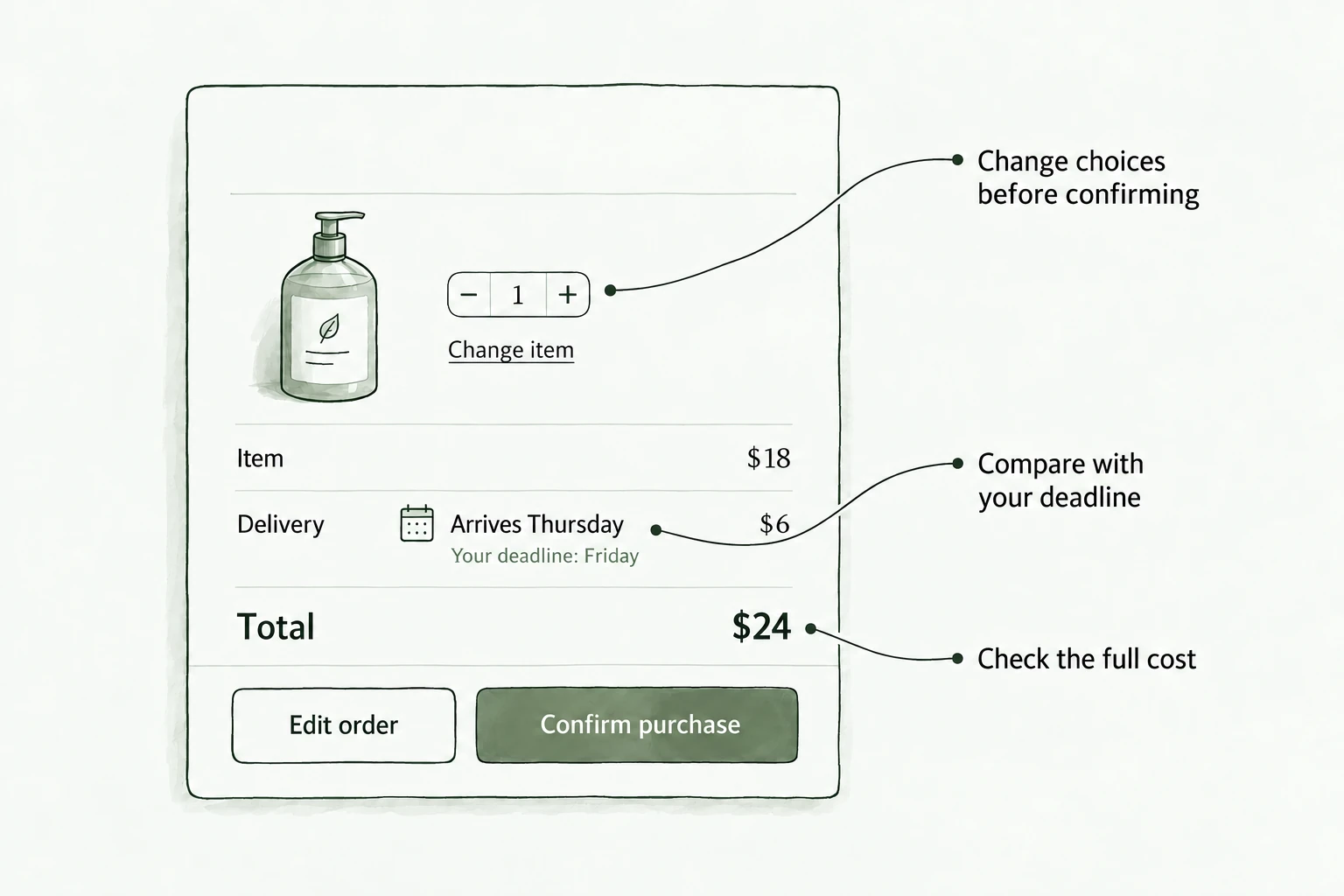
The review should bring the customer's important constraints back into view. If delivery drove the recommendation, show the proposed arrival date beside the original deadline. If the assistant chose a substitute, make the change visible and explain how it fits the request.
The explanation should help someone judge the proposed order against their request. It should also be possible to replace an item or change its quantity from the review, without restarting the conversation.
The full cost belongs there too, including delivery or other charges that affect the decision. An estimated delivery date needs to look like an estimate. Commercial influence, such as a paid placement, should be disclosed before purchase because it affects how the customer judges the recommendation.
Agree on the limits of authority
The assistant needs to know which conditions it must preserve when making a choice. A spending ceiling is useful, but it won't capture every reason a customer would reject an order. Someone might accept a different brand of refill bottle and still need it before Friday. A cheaper replacement arriving on Monday would fail that request.
Those limits need to be understandable and editable. The team also has to decide what happens when the assistant cannot satisfy them. It may need to ask the customer to choose between waiting and accepting a change. That question should explain the consequence clearly enough for someone to answer without reconstructing the earlier comparison.
Repeated confirmation has a cost of its own. If the assistant stops at every small step, the customer can end up doing much of the supervision the product was meant to reduce. I would test where people actually need to reconsider a decision and give those moments enough context to be useful.
Keep the information current
The information used to assemble the basket needs to remain current through checkout. Stock and delivery estimates can change while an order is being assembled. If the arrival date changes before payment, the customer needs to see that change while there is still an opportunity to choose another item.
This needs agreement with the people maintaining the product data and checkout systems. Which system can confirm availability? How does a changed price reach the review? The design depends on those answers. A recommendation and a payment flow reading different versions of the information can leave the customer with an order that no longer matches what they approved.
When confirmation is unavailable, the product needs a defined response. It could wait for an update or offer another option. The appropriate choice depends on what the customer has authorized and what the retailer can reliably promise. The interface needs to make that uncertainty specific to the order.
Keep a usable purchase record
The review is also the start of the record someone will need if the purchase goes wrong. The original instruction should remain connected to the order placed, including any change the customer approved. A later view of the conversation alone may leave support staff working out which version of the request applied.
I would include support staff when testing that recovery path. Give them the purchase record and check whether they can establish what was authorized, identify the discrepancy and find the available correction. That can reveal missing information before it becomes part of a customer's complaint.
The customer needs access to the same basic account of what happened: the request that applied at purchase, the confirmed order and the route for asking for a correction. That record should be available without requiring them to repeat the instructions they already gave.
References
- Elizabeth Silliman, Jack Trotter and Kelsey Robinson, with Desirae Oppong and Shreya Jaggi, Who wins when AI does the shopping?, McKinsey, October 28, 2026. June 2026 survey; bases vary by exhibit. Purchase comparison uses December 2025.