Choosing when an agent should explain or pause

An assistant arranging a meeting can check availability, choose a time and prepare an invitation without requiring someone to watch each step. Its work becomes more consequential when it includes a person outside the organization or carries an internal agenda into the invitation. The user needs to understand that choice while there is still time to change it.
Designing the right interruption requires knowing where the choice occurs. A confirmation at the end may arrive after information has already been shared. Frequent progress messages can consume attention without helping anyone recognize that boundary. The team needs to decide which events deserve a visible response and what the person can do at each one.
Victor Yocco proposes a Decision Node Audit that connects an agent's internal choices with interface explanations. His method maps the process with the people building it and identifies uncertain decisions. An Impact/Risk matrix helps prioritize disclosure; a later rubric uses reversibility to select an interface pattern. He also recommends observing where users question the agent's behavior. He illustrates the method with worked examples, and the article does not present controlled evidence that it improves trust.
A product team can use that mapping to locate decisions that need the user's attention and establish whether the agent should pause. Showing information, asking for a choice and pausing the task each change what the person can still do.
Follow one task through its decision points
Start with a complete task the product actually supports. For the meeting assistant, follow the request through calendar access and recipient selection to the eventual send operation. Include the branch taken when a calendar is unavailable. The ordinary path alone won't reveal where the assistant substitutes an assumption for missing information.
At each branch, identify what could change for the user. Selecting an available room may stay within the request. Adding an external guest could change who can see the agenda. The relevant boundary depends on the instruction the person gave and the permissions the product has established.
This conversation needs the engineer who can explain the actual sequence. If the product prepares the invite before checking recipients, the design must allow that draft to remain private. If it sends first and requests confirmation afterward, changing the wording of the dialog will leave the underlying problem in place.
Record the last point at which the user could prevent the consequence. That becomes a candidate location for intervention. The screen design can then be checked against a specific action boundary.
Separate information from permission
A useful status message explains a condition the person needs to understand. If a calendar is disconnected, the assistant should identify whose availability it could not check. Someone can then decide whether to continue with that uncertainty. A message saying that the assistant is working offers little help with that decision.
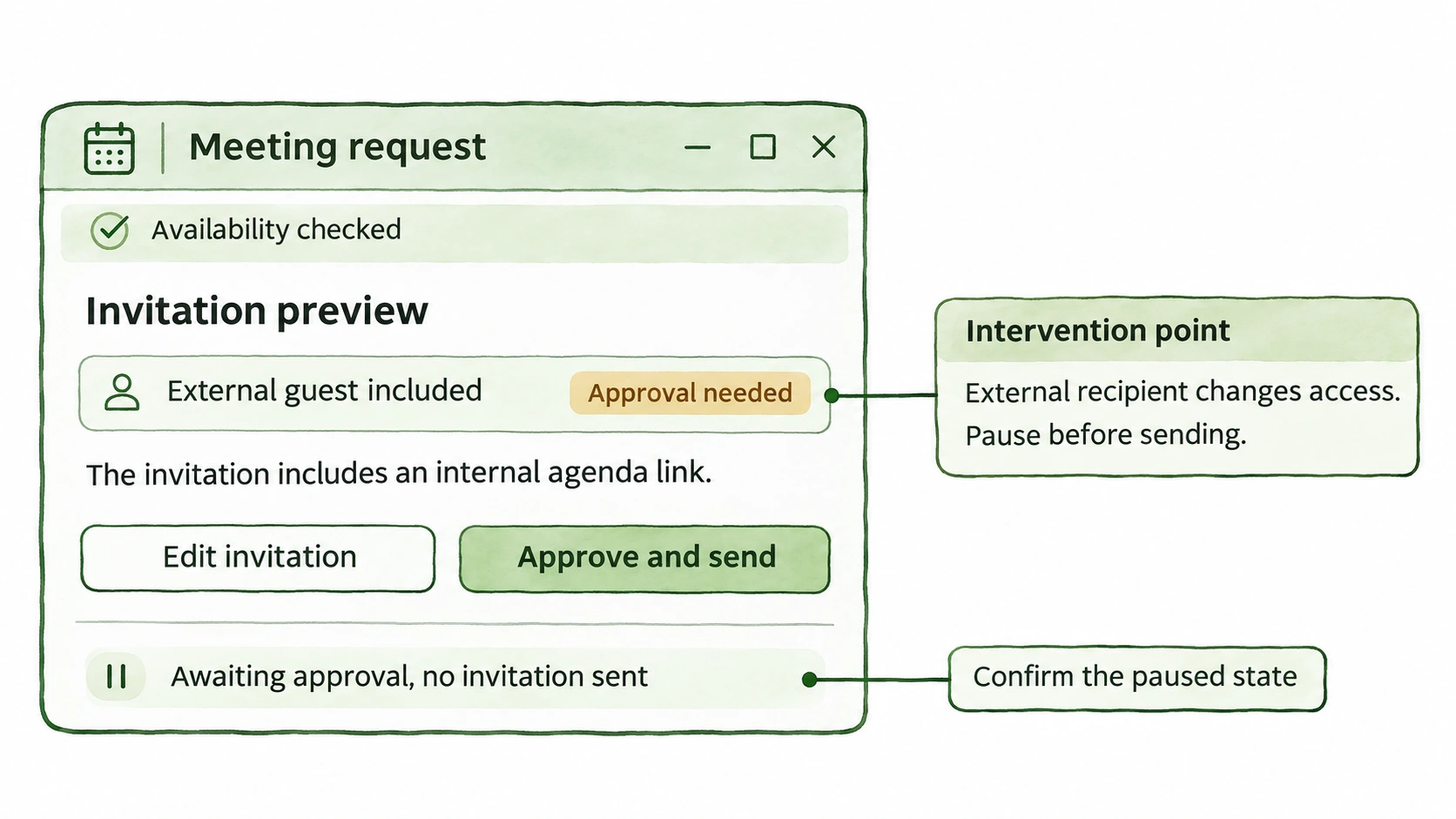
Permission requires an additional step. Before sending an invitation containing an internal link to an external recipient, show the recipient and the material they would receive. Give the person a way to edit the invitation while retaining the scheduling work already completed. The approval should specify which recipient will receive which material.
I would be careful about using reversibility as the sole test. Deleting a sent invitation may remove it from a calendar while leaving the recipient with information they have already seen. An undo control has to be assessed against the consequence the user cares about. A successful technical reversal can still leave that consequence unresolved.
Make each message traceable to a system event
The team needs to establish what the software can truthfully report. A planned step and a completed check should produce different messages. If the assistant has requested availability but the service has not replied, the interface should retain that distinction.
NIST's Four Principles of Explainable Artificial Intelligence distinguishes understandable explanations from explanations that accurately reflect the process producing an output. It also identifies the system's knowledge limits as a separate concern. A reassuring explanation can be easy to understand and still misrepresent what happened.
For the invitation, a completed availability check needs a corresponding result. The approval state needs a dependable way to prevent sending until the person acts. If the product cannot obtain the required result, say which check remains incomplete. Avoid filling that gap with a plausible account generated by the model.
An internal matching score needs similar scrutiny before it appears in the interface. The team should understand what it measures and whether that meaning will help the person decide. Calling it confidence can imply a probability of correctness that the underlying score has not established. Often the more useful disclosure is the concrete uncertainty, such as a recipient whose organization could not be confirmed.
Test whether the interruption helps a decision
A prototype test should include a task where the user can reasonably let the assistant continue, alongside a case requiring a change. For the latter, give the external recipient a plausible role in the task so the participant has to consider what they would receive. Observe whether the person notices the disclosure and understands what approval would permit.
Afterward, ask what they believe has already happened. Someone who correctly spots the external guest may still assume the invitation was sent before the prompt appeared. That misunderstanding changes how they respond. The paused state needs to be as clear as the proposed action.
Also examine what happens after editing. Does the assistant preserve the selected time? Does it ask again when the recipient changes? The explanation and controls need to remain connected to the version the person is reviewing.
I would judge the interruption by the decision it makes possible. A participant saying the assistant feels trustworthy provides useful feedback about perception, but it doesn't establish that they recognized the relevant consequence. The stronger test is whether they can explain what will happen next and make an appropriate change before it happens.
The final design should leave the team with a small set of justified interventions, each tied to a consequence and a verifiable system condition. Once an action has occurred, confirming its resulting state becomes the next task. The earlier transparency work determines whether the person had a meaningful opportunity to influence it.
References
- Victor Yocco, Identifying Necessary Transparency Moments In Agentic AI (Part 1), Smashing Magazine, April 7, 2026.
- P. Jonathon Phillips and colleagues, Four Principles of Explainable Artificial Intelligence, NISTIR 8312, September 2021.